
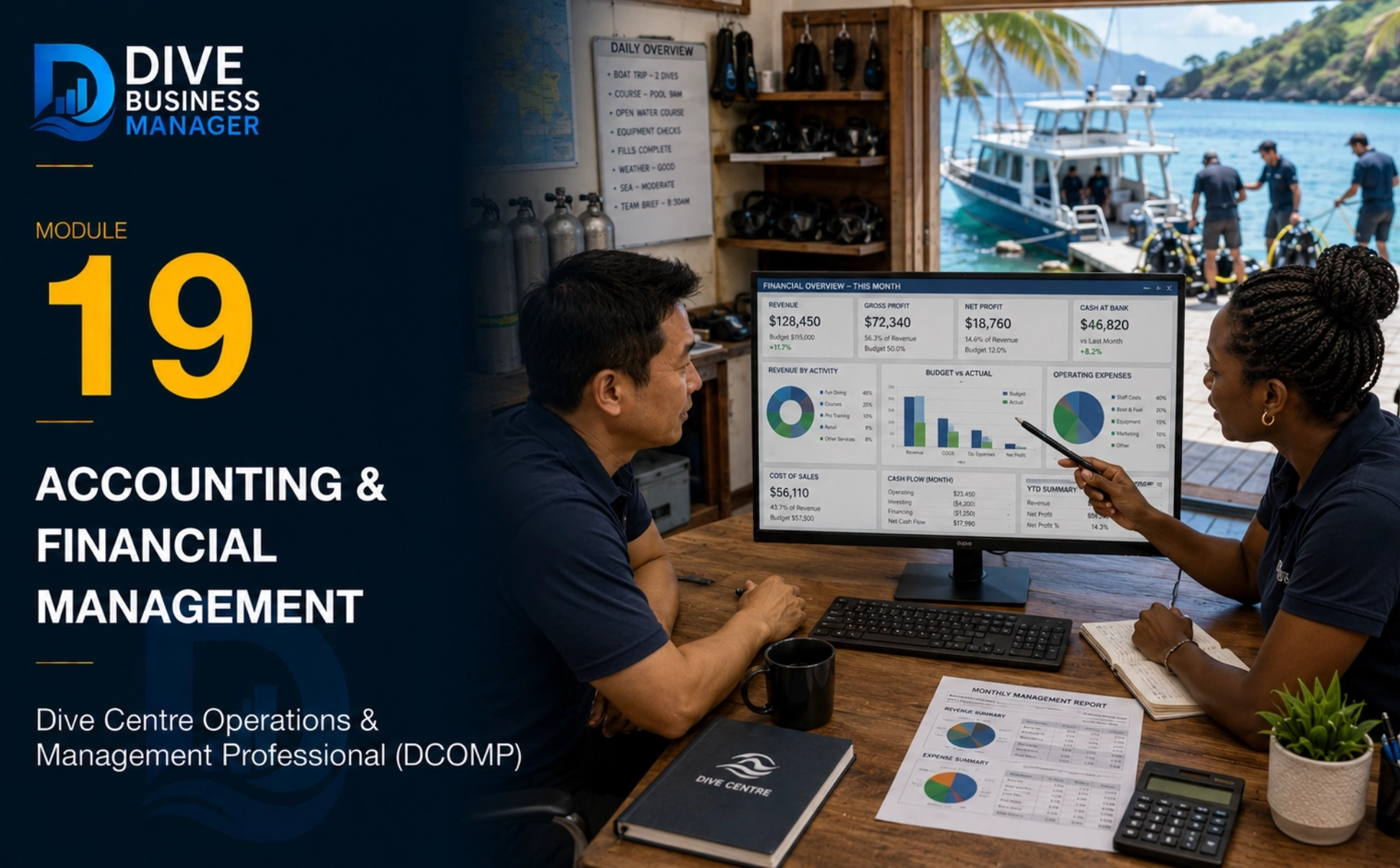
Module 19: Accounting & Financial Management
Wishlist Share

About Course

This module explores how sound financial management helps a dive centre control costs, maintain healthy cash flow and make informed business decisions.


Learners examine the three principal financial statements and develop an understanding of revenue, cost of sales, operating expenses, gross profit, net profit, assets and liabilities.


The module covers cash-flow management, accounts receivable and payable, budgeting, revenue forecasting, expense control and labour costs.


It also addresses inventory, capital expenditure, return on investment, financing, taxation, financial controls and cash-handling procedures.


Learners will consider how reporting schedules, financial ratios and warning signs contribute to a complete financial management system.

What Will You Learn?

  • Explain why financial management is essential to dive centre sustainability.
  • Identify the purpose of the three principal financial statements.
  • Read and interpret a profit and loss statement.
  • Distinguish between cost of sales and operating expenses.
  • Identify and evaluate the dive centre’s principal revenue streams.
  • Calculate and interpret gross profit and gross margin.
  • Calculate and interpret net profit.
  • Explain the structure and purpose of a balance sheet.
  • Distinguish between profit and cash flow.
  • Monitor cash inflows, outflows and expected cash requirements.
  • Manage accounts receivable and overdue customer balances.
  • Manage accounts payable and supplier obligations.
  • Develop practical operating and departmental budgets.
  • Forecast revenue using historical information, bookings and expected demand.
  • Identify opportunities to control expenses without compromising safety or quality.
  • Monitor labour costs and staffing efficiency.
  • Explain how inventory levels affect working capital and cash flow.
  • Evaluate and plan capital expenditure.
  • Calculate and assess return on investment.
  • Understand the financial implications of loans and other financing.
  • Coordinate taxation and statutory obligations with qualified professionals.
  • Implement effective financial controls and approval procedures.
  • Establish secure and accountable cash-handling procedures.
  • Develop an appropriate financial reporting schedule.
  • Use relevant financial ratios to monitor business performance.
  • Recognise warning signs of financial difficulty.
  • Build a structured and reliable financial management system.

Course Content

Module 19- Accounting & Financial Management
Learn how to understand financial reports, manage budgets, control costs, monitor cash flow and use financial information to make informed business decisions that support profitability and long-term sustainability.

  • Overview
  • Learning Outcomes
  • Why Financial Management Matters
  • The Three Financial Statements
  • Profit & Loss Statement
  • Cost of Sales and Operating Expenses
  • Revenue Streams
  • Gross Profit
  • Net Profit
  • Balance Sheet
  • Quick Quiz 1
  • Cash Flow
  • Accounts Receivable
  • Accounts Payable
  • Budgeting
  • Revenue Forecasting
  • Expense Control
  • Labour Cost Management
  • Quick Quiz 2
  • Inventory and Cash
  • Capital Expenditure
  • Return on Investment
  • Financing and Loans
  • Taxation and Statutory Obligations
  • Financial Controls
  • Cash Handling Procedures
  • Financial Reporting Schedule
  • Financial Ratios
  • Financial Warning Signs
  • Building a Financial Management System
  • Quick Quiz 3

Earn a certificate

Add this certificate to your resume to demonstrate your skills & increase your chances of getting noticed.
selected template