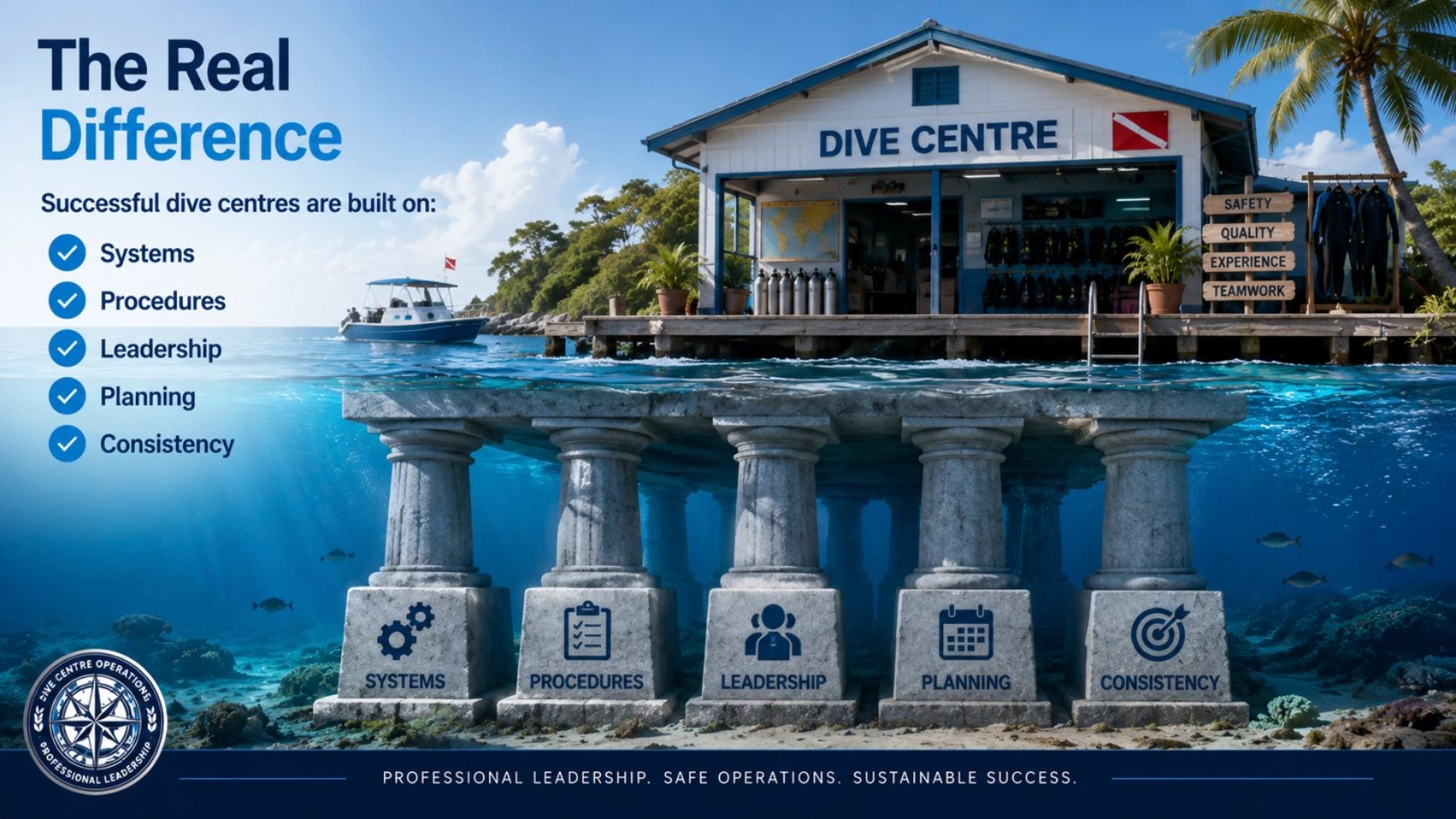
Success Is Built on Systems
When people describe a successful dive centre, they often focus on what they can see. Experienced instructors, attractive dive sites, comfortable boats and modern equipment all contribute to the quality of the customer experience. These are important assets, but they do not explain why some operations perform consistently while others struggle with repeated disruption.
A dive centre can have excellent instructors and still deliver poor service. It can own a well-equipped boat and still depart late every morning. It can invest heavily in rental equipment and still discover that the correct sizes are unavailable when customers arrive.
The difference is often not the quality of the individual assets. It is the quality of the systems that manage them.
What Makes Performance Repeatable?
An exceptional day can happen by chance. Consistent performance cannot.
A team may occasionally overcome poor planning through extra effort, personal experience or last-minute problem-solving. An instructor may find replacement equipment for a customer. A captain may delay departure while missing cylinders are located. A manager may personally resolve a booking error before it becomes a complaint.
The customer may still have a good day, but the operation has succeeded despite its systems rather than because of them.
This distinction matters.
Businesses that depend on individual heroics are vulnerable. Performance changes according to who is working, how busy the centre is and whether experienced staff are available to intervene. As activity increases, informal arrangements that once seemed adequate begin to fail.
A well-managed operation aims to make good performance repeatable. It establishes reliable methods for completing important tasks and creates enough visibility for management to know whether those methods are working.
The Systems Customers Never See
Much of the infrastructure supporting a dive operation remains invisible to the customer.
Maintenance schedules help ensure that boats, vehicles, compressors and equipment remain available. Compressor logs provide evidence of operational control and support maintenance and air-quality management. Staff rosters ensure that qualified personnel are available for the activities being delivered. Inventory records help prevent shortages. Booking procedures translate customer enquiries into accurate operational information.
None of these systems is likely to appear in a customer’s holiday photographs.
Yet their absence quickly becomes apparent.
A late boat departure may originate from poor cylinder allocation, incomplete equipment preparation or an unrealistic schedule. Missing equipment may reflect weak inventory control rather than a lack of equipment overall. A booking error may begin with incomplete information recorded several days earlier. Confused staff may simply be working from different versions of the day’s plan.
What the customer experiences as a single service failure may therefore be the final result of a much earlier process failure.
Systems Connect People and Information
A system is more than a form, checklist or piece of software. It is an organised way of ensuring that a necessary activity happens reliably.
Consider a simple customer booking. The reservation itself may need to capture certification level, experience, equipment requirements, medical considerations, transport arrangements, payment status and the activity requested. That information may then affect staffing, boat capacity, equipment preparation and the choice of dive site.
If information is recorded accurately but never reaches the operational team, the system has failed. If the process depends on one person remembering to tell everyone else, it remains vulnerable.
Effective systems connect information, responsibility and action.
This is why purchasing new software does not automatically improve an operation. A sophisticated booking platform cannot compensate for poor data entry. A digital maintenance system is ineffective if servicing is not completed. A checklist has little value if staff sign it without carrying out the checks.
The tool supports the system. It does not replace management.
From Reactive to Controlled Operations
Weakly managed businesses spend a significant amount of time reacting.
The morning begins with questions. Which customers are coming? Who is guiding them? Where is the correct equipment? Which cylinders are ready? Has the boat been fuelled? Who is collecting the guests?
Each question may be answered eventually, but repeated uncertainty consumes time and creates unnecessary pressure.
A controlled operation answers most of these questions before they become urgent.
This does not mean that unexpected problems disappear. Weather changes. Customers arrive late. Equipment can fail. Staff may become unavailable. The value of strong systems is that the routine elements of the operation are already under control, leaving the team with greater capacity to manage genuine exceptions.
When everything is treated as an emergency, management becomes firefighting. When routine activities are systemised, management can focus on decisions that actually require judgement.
Consistency Defines Professionalism
Customers do not usually expect extraordinary performance at every moment. They expect the business to deliver what it promised, safely and reliably.
They expect accurate information. They expect the correct equipment to be available. They expect staff to understand the plan. They expect reasonable punctuality and competent communication. When circumstances change, they expect the situation to be managed professionally.
These expectations are achieved through consistency.
One excellent instructor cannot compensate indefinitely for a disorganised operation. A beautiful reef cannot correct repeated booking errors. A new boat loses much of its value if poor maintenance regularly removes it from service.
Professionalism is therefore demonstrated not only through impressive facilities or individual expertise, but through the organisation’s ability to deliver a dependable standard day after day.
Systems Must Fit the Operation
There is no single management system suitable for every dive business.
A small owner-operated centre may use straightforward checklists, spreadsheets and direct communication. A large resort operation may require departmental procedures, integrated booking software and formal reporting structures. A liveaboard, seasonal dive school and urban training centre will each have different operational requirements.
Complexity should never be introduced simply to make a business appear more professional.
The right system is one that is proportionate to the operation, understood by the people who use it and reliable under normal working conditions. It should reduce uncertainty, clarify responsibility and provide management with useful information.
A simple system that is followed consistently is more valuable than an elaborate system that exists only on paper.
Best Practice
Build systems around the activities that must happen correctly every time. Keep them practical, make responsibilities clear and verify that they work in real operations. Professionalism is rarely defined by one exceptional performance. It is demonstrated by the ability to deliver a reliable standard consistently.